VITAMIN
D
DEFICIENCY
INCREASES RISK OF HIP FRACTURE IN OLDER WOMEN
Underlying
vitamin D
deficiency
in post-menopausal women is
associated with increased risk of hip fracture, according
to investigators at Brigham and Women's Hospital in Boston,
Massachusetts.
In a
group of women with
osteoporosis hospitalized for hip fracture, 50
percent were found to have a previously undetected vitamin D
deficiency. In
the
control group, women who had not suffered a hip fracture but who were
hospitalized for an elective hip replacement, only a very small
percentage
had vitamin D deficiency,
although one-fourth of those women also had osteoporosis.
These
findings were reported
in
the April 28, 1999, issue of the "Journal of
the American Medical Association". The study, conducted by Meryl S.
LeBoff,
MD; Lynn Kohlmeier, MD; Shelley Hurwitz, PhD; Jennifer Franklin, BA;
John
Wright, MD; and Julie Glowacki, PhD; of the Endocrine Hypertension
Division,
Department of Internal Medicine, and Department of Orthopedic Surgery,
Brigham and Women's
Hospital, Boston, was supported by grants from the National Institute
on
Aging (NIA) and the National Center for Research Resources (NCRR),
components of the National Institutes of Health.
These
investigators studied
women admitted to either Brigham and Women's
Hospital or the New England Baptist Hospital, both in Boston, between
January 1995 and June
1998. A group of 98 postmenopausal women who normally reside in their
own
homes were chosen for the study. Women with bone deterioration from
other
causes were excluded from the study. There were 30 women with hip
fractures
caused by osteoporosis and 68 hospitalized for elective joint
replacement.
Of these 68, 17 women also had osteoporosis as determined by the World
Health Organization
bone density criteria. All the participants answered questions
regarding
their
lifestyle, reproductive history, calcium in their diet, and physical
activity. Bone mineral density of the spine, hip, and total body were
measured by dual X-ray absorptiometry
(DXA) technique, as was body composition. Blood chemistry and urinary
calcium levels were analyzed.
The two
groups of women with
osteoporosis did not differ significantly in
either time since menopause or bone density in the spine or hip. They
did,
however, differ in
total bone density. The women admitted for a hip fracture had fewer
hours
of exercise than the control group. Fifty percent of the women with hip
fractures were
deficient in vitamin D, 36.7 percent had elevated parathyroid hormone
(PTH)
levels (a hormone which can stimulate loss of calcium from bone), and
81.8
percent had
calcium in their urine, suggesting inappropriate calcium loss. Blood
levels
of calcium were lower in the women with hip fractures than in either
elective group.
These
researchers propose
that
vitamin D supplementation at the time of
fracture may speed up recovery and reduce risk of fracture in the
future.
Current Dietary Reference Intake Guidelines contain a daily
recommendation
of 400 IU of vitamin D for people aged 51 through 70 and 600 IU for
those
over age 70.
"We
know that a calcium-rich
diet and regular weight-bearing exercise can
help prevent osteoporosis. This new research suggests that an adequate
intake of vitamin D, which the body uses to help absorb calcium, may
help
women to reduce their risk of hip fracture, even when osteoporosis is
present," observed Dr. Evan C. Hadley, NIA
Associate Director for geriatrics research.
"Osteoporosis
leads to more
than 300,000 hip fractures each year, causing
pain, frequent disability, and costly hospitalizations or long-term
care.
Prevention of such fractures would greatly improve the quality of life
for
many older women and men,
as well as significantly reduce medical costs."
The
bones in the body often
undergo rebuilding. Some cells, osteoclasts,
dissolve older parts of the bones. Then, bone-building cells known as
osteoblasts create new
bone using calcium and phosphorus. As people age, if osteoporosis
develops,
more bone is dissolved than is rebuilt, and the bones weaken and become
prone to fracture.
Also in many older persons, levels of vitamin D in the blood are low
because
they eat less or spend less time in the sun, which stimulates the
body's own
production of vitamin D.
Experts
do not understand
fully
the causes of osteoporosis. However, they
do know that lack of estrogen which accompanies menopause, diets low in
calcium, and lack of
exercise contribute to the problem. Eighty percent of older Americans
who
face the possibility of pain and debilitation from an osteoporosis
-related
fracture are
women. One out of every two women and one in eight men over the age of
50
will have such a fracture sometime in the future. These fractures
usually
occur in the hip,wrist, and spine.
SOURCE: M.S. LeBoff, L.
Kohlmeier, S. Hurwitz, J. Franklin, J.
Wright, and J. Glowacki, "Occult Vitamin D Deficiency in Postmenopausal
US
Women with Acute Hip Fracture," "Journal of the American Medical
Association", 251:16, pp. 1505-1511, 1999.
To
get
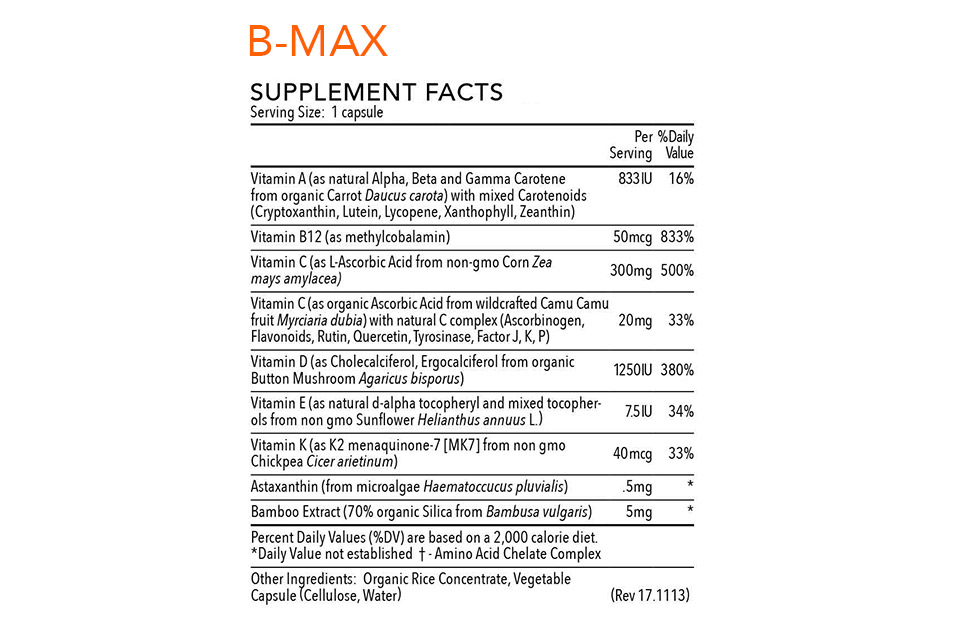
your vitamin D take B-Max
daily multi vitamin.